
S&T Brief: PRC Scientists Study BWBUG "Blockade Capability"

Scientists affiliated with Northwestern Polytechnical University recently published a paper in the journal Ships and Offshore Structures exploring the potential for blended wing body underwater gliders (BWBUGs) to be deployed in a combat role.
-
The paper is largely conceptual in nature, focusing on the weapons utility of BWBUGs when deployed as a "multi-BWBUG cooperative system," a self-organizing underwater mesh network of autonomous underwater vehicles (AUVs), or undersea swarm.
-
Other than a reference to the BWBUG's "advantages of high endurance and low noise," there is no analysis of specific BWBUG performance capabilities or characteristics. Notably, there is no mention of the BWBUG's abilty to accommodate heavy payloads, one of its defining characteristics, which would enable it to carry large hydrophone arrays and combat systems, such as lightweight torpedoes or specialized ordnance for striking seabed targets.
-
The term "blockade" is not specifically defined, but appears to be a combined reference to anti-submarine warfare (ASW) screening operations, and seabed warfare.
-
Rather than arm each individual vehicle/node, the authors' concept calls for a single, "primary" vehicle to carry the combat payload, while other vehicles act as sensing, communication, and targeting nodes.
-
The authors' propose various network topologies, and then express overall BWBUG "blockade capability" as a factor of "occurrence probability of network state," vehicle "inherent capabilities," and, for the primary vehicle, "combat capability."
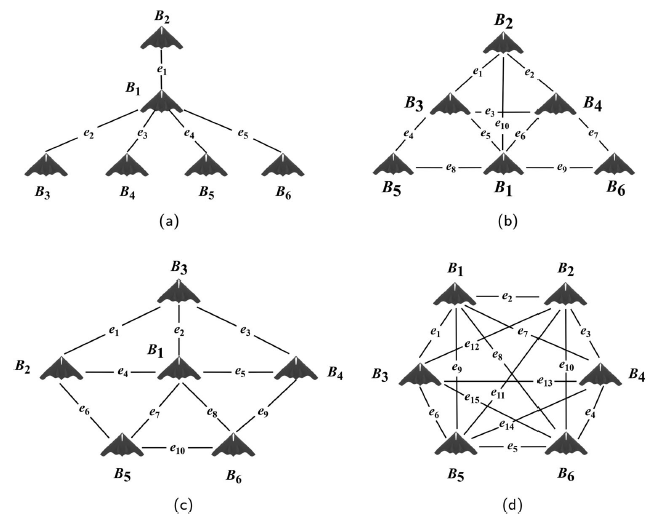
‣ Occurrence probability of network state is a factor of acoustic transmission properties such as divergence loss, attenuation, surface and seabed reflection loss, and latency.
‣ Inherent capability is expressed as transmission delay, which is a factor of transmission path length, data transmission quantity, data transmission rate, and the number of communication links.
‣ Combat capability is a factor of connectivity between the primary and secondary BWBUGs, as well as torpedo hit probability derived from a Monte Carlo calculation.
-
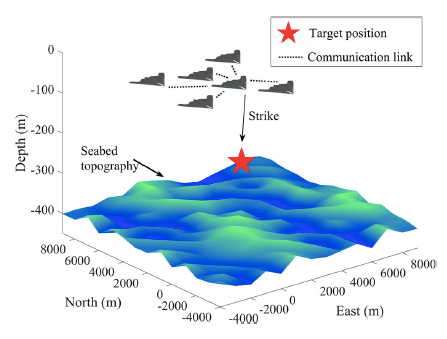
The article alludes to a seabed strike capability, however there is no explanation or analysis of how the swarm would detect, identify, localize, and engage targets residing on the ocean floor.
-
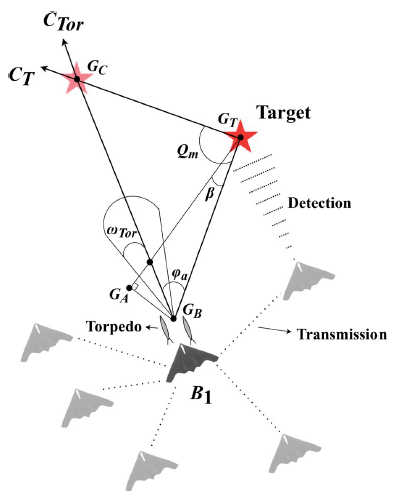
There is a detailed numerical analysis of an ASW tactical CONOP, focusing largely on torpedo motion, sonar detection, and targeting/homing.
-
The authors' propose an algorithm to determine blockade capability, which they use to simulate the effects of communication, detection range, and network reliability.
-
Based on the simulation, the authors' conclude:
‣ Communication frequency can have an impact on network readiness, as can the source level, which they indicate should be greater than 170dB in order to ensure proper functioning of all communication links.
‣ Overall blockade capability decreases as comms link failure rate increases, and as such an increase in comms links will increase blockade capability.
‣ Combat capability increases as the number of primary communication links (i.e. those connected with the primary BWBUG) increases.
‣ Blockade capability generally increases with an increase in passive sonar detection range, with a rapid increase as range surpasses 4000 meters.
-
While the focus of the paper is BWBUG swarm operations, the authors' concede that there is no (publicly available) research concerning the "cooperative capability" of this type of vehicle, and therefore rely on prior (primarily PRC) scientific research exploring general AUV autonomy/swarming, communication, navigation, and sensing.
-
Prior Strikepod products have focused on Chinese scientific interest in BWBUGs, as well as their potential to be weaponized and structured as an underwater mesh network for use in offensive mine warfare.
‣ Chinese Research on Blended Wing Underwater Gliders
‣ Mind the Gliders - Overview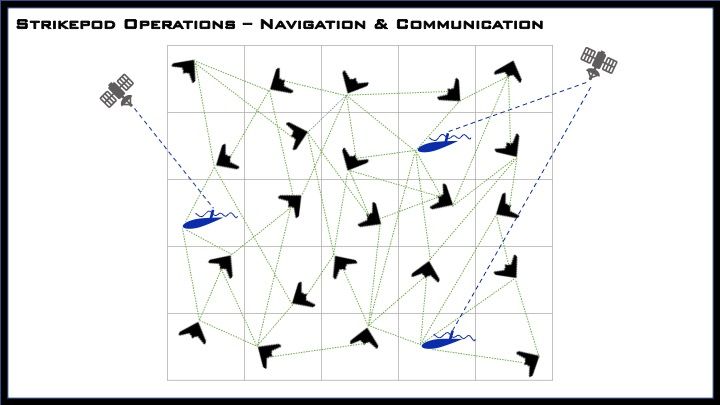
-
Since 2015, PRC scientists have published some sixty papers related to BWBUG design and operation, such as hull shape optimization, hydrodynamic performance, path planning, swarming, and its potential role in seabed warfare and ASW.
CONCLUSION:
This paper underscores continued PRC interest in the BWBUG as a potential multi-role combat platform, and adds to an expanding body of BWBUG S&T analysis by scientists affiliated with universities tied to the People's Liberation Army Navy (PLAN).
CITATION:
Huang, H., Liang, Q., Hu, S., Yang, C., & Luo, M.
Numerical investigation for the blockade capability of the multi-BWBUG cooperative system
Ships and Offshore Structures
March, 2024
