
⿻ Mobile Ordnance Aquatic Munition (MOAM) Enters Sea Trials

The U.S. Navy's Mobile Ordnance Aquatic Munition (MOAM), or what is becoming known colloquially as the "Mother of All Mines," could be key to offsetting shipbuilding shortfalls while bolstering offensive mine warfare capability as it is integrated into the Navy’s Distributed Uncrewed Mesh Baseline (DUMB) architecture.
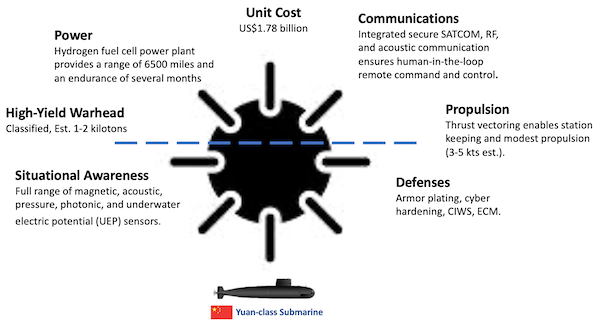
With an estimated warhead yield of between 1 and 2 kilotons, MOAM is a strategic maritime system of unprecedented scale and destructive power.
- Capable of both surfaced and submerged operations, MOAM was conceived as an enormous drifting influence/contact mine, which the Navy firmly believes - given the weapon’s history, symbolism, and continued use today - will strike great fear into the heart of any adversary.
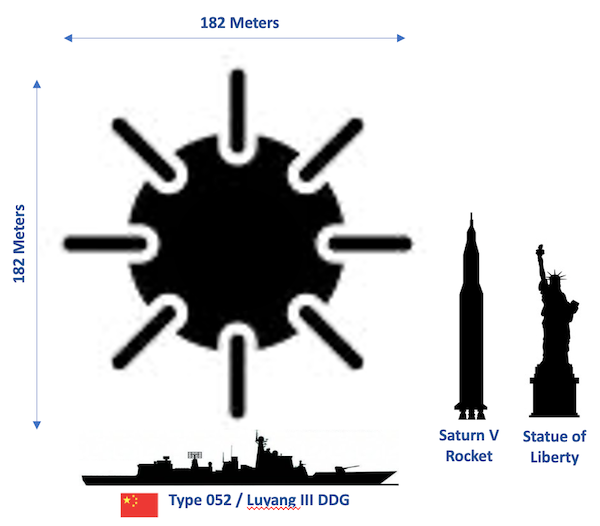
- At nearly 182 m (nearly 600 feet) in diameter, MOAM is taller than a Saturn 5 rocket or the Statue of Liberty, and slightly wider than a Luyang III destroyer.
- While not capable of the high speed or cobalt salting of Russia’s Poseidon, we need only look at the 2020 2.5 kiloton blast in the Port of Beirut to understand the devastation that MOAM could bring.
- According to a 30-slide USN Powerpoint, at current projected unit costs, MOAM compares favorably to DDG procurement on a "per-square-mile-of-denial" basis, and will "enable persistent omnidirectional overmatch in denied littoral spaces."
MOAM is equipped with an array of advanced technologies that make it arguably more of an unmanned warship than mine.
- Hydrogen fuel cell power enables a range in excess of 6500 nautical miles, and an endurance of several months.
- Thrust vectoring enables station-keeping and a speed of 3-5 kts.
- An integrated sensor suite including magnetic, acoustic, pressure, photonic, and underwater electric potential (UEP) detection modalities enables near-omniscient situational awareness.
- An array of communications systems, including SATCOM, RF, WiFi, acoustic, and high-bandwidth optical, ensures human-in-the-loop remote command and control.
- Defensive systems, such as CIWS, electronic countermeasures, cyber hardening, and armor plating, enable assured survivability against a wide range of kinetic and non-kinetic threats.
Strikepod Systems recently attended a series of high-level unclassified wargames featuring the MOAM in various concepts of operation.
- Time and time again, the Blue team was able to effectively seal off critical strategic chokepoints, such as the Luzon Strait and GIUK Gap, with a handful of MOAMs.
- The participants, representing the U.S. Marine Corps, Navy, and Coast Guard, were visibly stunned by the MOAM's effectiveness as a weapon of both sea denial and sea control, with one observer overheard remarking, "Bro, this thing is sick."
CONCLUSION:
The Navy’s vision for MOAM is unclear. As an unmanned surface warship, MOAM could provide a highly visible forward presence to deter aggression and reassure allies. As a mine, MOAM could hold adversary surface ships and submarines at risk, as well as port facilities and coastal infrastructure.
Further details remain limited at this time. We will continue to monitor MOAM's development and update as events dictate. Meanwhile, it should (hopefully) go without saying: Happy April Fools' Day!
