
Iranian Undersea Options to Disrupt the Strait of Hormuz

While the threat of a Strait of Hormuz closure has diminished following a tenuous ceasefire with Israel, Tehran is likely to continue leveraging the strait as a means of disruption and strategic signaling.
- Periodic threats of closure spook global markets, drive up insurance rates, and increase oil prices, enhancing Iran’s image as a regional power and maritime gatekeeper.
- Control or influence over the strait reinforces Tehran's perceived role as guardian of Persian Gulf security and counterweight to U.S. dominance, which in turn reinforces regime cohesion, legitimacy, and revolutionary identity.
- An outright closure, if achievable, would be an act of strategic suicide for Tehran, and would likely be attempted only if the regime were facing existential collapse, as any serious blockade attempt would trigger a decisive U.S. response.
POSSIBLE CONOPS FOR DISRUPTION:
▶︎ Coordinated surface minelaying by Islamic Revolutionary Guard Corps Navy (IRGCN) fast boat squadrons to establish a structured minefield.
- Effective if unopposed by a U.S. naval presence, although "suicide" minelaying operations, layered with crewed or uncrewed fast boats to distract, overwhelm, or strike warships, is also a possibility.
- Structured minefields would enable a prolonged closure, but would represent a highly escalatory move and likely invite prompt U.S. retaliatory action.
- The United States could take preemptive action, or interdict minelaying vessels while underway, in order to prevent closure operations before they commence.
▶︎ Covert undersea minelaying or torpedo ambush operations using Ghadir-class midget submarines inside the Gulf.
- Effective for initial disruption, to deny safe anchorages and approaches, and to sow uncertainty.
- Unlikely to be sustained given the Ghadir's limited endurance and weapons payload, U.S. anti-submarine warfare (ASW) operations, and that Bandar Abbas, the Ghadir base of operations, would be targeted during a U.S. naval response.
▶︎ Strike UUV deployments from fast boats, submersibles, or shore points with access to shipping lanes or operational areas of U.S. warships.
- Open source or Iranian intelligence would identify bearing, course, and speed of approaching vessels, which could then be used to plot firing solutions.
- Strike UUVs could be deployed over the side of surface vessels, from submarines/submersibles, or from points along the Iranian coastline, or from Iran-controlled islands, such as Abu Musa or Greater/Lesser Tunbs. Weapon engagement zone (WEZ) dimensions would be determined by vehicle range/endurance and guidance method.
- Unguided/INS Vehicles: Attacks would likely originate from close range, in salvos of several vehicles, likely from multiple attack vectors in order to overwhelm target defenses and maximize kill probability.
- Guided Vehicles: Attacks could originate from longer range, using single vehicles or smaller salvos. This would include wake homing vehicles, as they would need only to intercept the wake of the target vessel, turn, and home.
▶︎ Intermittent precision air strikes from shore-based drones and missiles against commercial and naval vessels, coupled with sporadic surface strikes by USVs and mine/UUV deployments from fast boats, civilian-flagged vessels, or fishing dhows.
- Follows a Red Sea model to toxify the maritime environment and exert pressure on commercial and naval planners.
- Creates operational uncertainty or paralysis while preserving strategic ambiguity.
RELEVANT UNDERSEA ORDER OF BATTLE
Iran possesses a range of undersea platforms and weapons, but their operational status and/or viability is largely unverified.
- During Operation Rising Lion, Israel struck drone storage facilities at the port of Bandar Abbas. It is unclear whether warships (to include submarines) or undersea drones were also targeted, or were damaged during the attack.
- Several surface vessels were observed hastily exiting the port of Bandar Abbas prior to the Israeli strikes. Ghadir-class submarines may also have been a part of this exodus. With tensions easing, vessels may have returned to port.
SUBMARINES
| Class | Type | Origin | Estimated Number | Status |
|---|---|---|---|---|
| Tareq | Diesel-electric | Russia | 3 | Kilo-class boats modified by Iran |
| Fateh | Diesel-electric | Indigenous | 1 | Coastal sub; limited operational details. |
| Ghadir | Midget | Indigenous (DPRK Yono design) |
14 | Built for guerrilla ops in shallow Gulf waters. |
| Nahang | Midget | Indigenous | 1 | Prototype/testbed or special ops platform. |
▶︎ NOTES:
- The current status of Iran's submarine fleet is unclear. In December, 2022, both Fateh and Kilo-class submarines reportedly took part in the Zulfiqar 1401 joint military exercise, and fired Valfajr torpedoes.
- A 2019 DIA report places the number of Ghadir-class submarines at 14. Other estimates place the number at up to 23.
SUBMERSIBLES/SWIMMER DELIVERY VEHICLES (SDVs)
| Platform | Type / Role | Length | Crew | Capabilities |
|---|---|---|---|---|
| e‑Ghavasi | SDV | ~5 meters | 1–2 | ISR, Minelaying |
| Al‑Sabehat 15 | SDV | ~8 meters | 2 + 3 divers |
ISR, Minelaying |
| Zulfikar | Submersible boat / SDV | ~17–21 meters | 3–8 | Torpedo attack, Special ops |
▶︎ NOTES:
- The e-Ghavasi SDV and Al-Sabehat 15 are capable of accommodating large payloads, and would enable operatives to transit underwater to a preplanned waypoint, then detach, activate, aim, and deploy a strike UUV.
- The dual 12.75 in (324mm) torpedo tubes of the DPRK-built Taedong-B (Zulfikar) can deploy lightweight torpedoes and strike UUVs.
TORPEDOES/SLCMs
| Name | Type | Origin | Estimated Range | Guidance | Notes |
|---|---|---|---|---|---|
| Hoot | Supercavitating | Indigenous | ~6NM | Inertial/Unguided | Based on Russian Shkval; reportedly capable of 200 knots |
| Valfajr | Heavyweight | Indigenous | ~8NM | Active/Passive Wake-homing |
Based on DPRK PT-97W, CHT-02D |
| Mark-46 | Lightweight | United States | ~6NM | Active/Passive | Acquired pre-Revolution |
| Jask-2 | SLCM | Indigenous | ~19NM | Unclear | Sub-Launched variant of the Iranian Nasr-1 |
▶︎ NOTES:
- Iran’s claimed Hoot torpedo capabilities should be viewed with skepticism.
- Iran has made significant efforts to reverse engineer or adapt foreign military systems, including torpedo systems, into its own defense industry framework.
- The Jask-2 SLCM can be fired from the Ghadir, Fateh, and Kilo-class submarines.
UNCREWED UNDERWATER VEHICLES (UUVs)
| Name | Type | Origin | Size | Status |
|---|---|---|---|---|
| Nazir-5 | UUV | Indigenous | Large/XL | Testing |
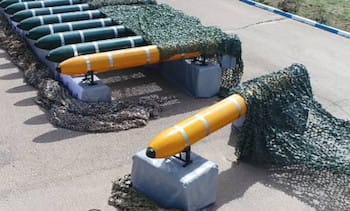
| Loitering Torpedo | Hybrid | Indigenous | Medium | Operational (Claim) |
| Strike UUV | Hybrid | Houthi/Indigenous | Medium | Operational (Claim) |
▶︎ NOTES:
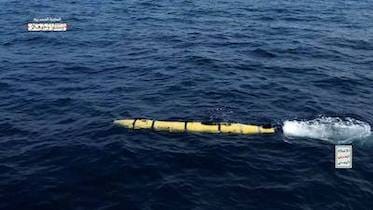
- The claimed Houthi strike UUV ("Al Qar'iah") bears a passing resemblance to the Remus-600 seized by the Houthis in 2018.
- There is no information regarding hybrid UUV/torpedo or Nazir-5 guidance, power/propulsion, endurance/range, or warhead size.
- If operational, these vehicles could be capable of acting as remotely controlled loitering munitions using real-time guidance from a remote operator.
- Nazir-5 dimensions suggest it could accommodate several batteries and a heavyweight warhead, enabling it to act as a long range strike platform.
- If the hybrid UUV/torpedo is based on the Valfajr, then the vehicle could utilize wake homing technology. However, if it possesses conventional UUV propulsion, the reduced thrust would likely prevent it from closing the distance to the target while operating in its wake.
- It is unlikely that any Iranian UUV is capable of acting as an autonomous loitering munition. However, a wake homing vehicle could use inertial navigation to transit to a waypoint and follow a preprogrammed route until it either intercepts a wake, or runs out of power.
- Strike UUVs could be deployed from a wide range of IRGCN/IRIN platforms, including both surface vessels and submarines. When launched from submarines, their quiet release and low acoustic signature, combined with the shallow, cluttered environment of the Persian Gulf, would significantly complicate detection and attribution, and would likely prevent ASW assets from establishing a reliable point of origin or bearing for counterfire.
▶︎ POSSIBLE PRIOR IRANIAN STRIKE UUV USE
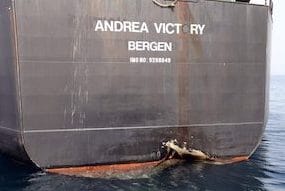
Iranian strike UUVs may have been used in a May, 2019, attack on commercial vessels anchored in the Gulf of Oman.
-
On May 12, 2019, four oil tankers - two Saudi, one Norwegian, one UAE - were attacked while anchored off the Port of Fujairah, UAE, resulting in five to ten foot holes at or below the waterline.
-
An official investigation concluded that the attacks were carried out by an anonymous state actor using limpet mines placed by divers or fast boat operatives.
-
According to Reuters, Norwegian insurer DNK concluded that the attack was carried out by the Islamic Revolutionary Guard Corps Navy (IRGCN), and that it "was likely to have been carried out by a surface vessel operating close by that despatched underwater drones carrying 30-50 kg (65-110 lb) of high-grade explosives to detonate on impact."
-
Images suggest a warhead capable of inflicting significant damage, possibly enough to disable a target vessel.
▶︎ Hybrid Loitering Torpedo/UUV: Via HI Sutton
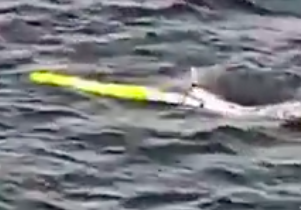
▶︎ Nazir-5: Via HI Sutton
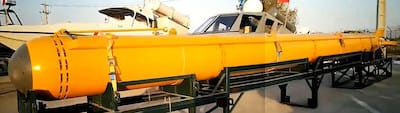
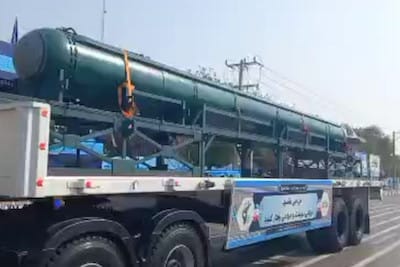
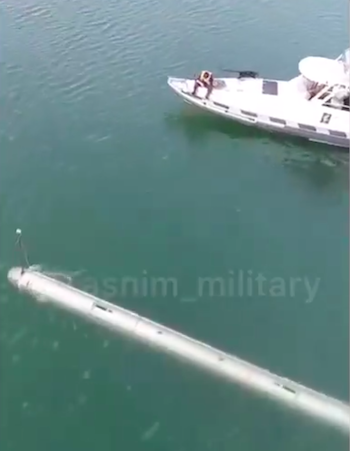
▶︎ Houthi Strike UUV:
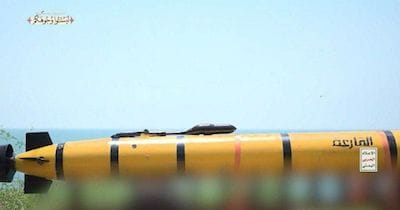 !
!
MINES
| Type | Delivery Method | Trigger Mechanism | Notes |
|---|---|---|---|
| Bottom | Submarine, Surface Ship, Helo | Magnetic/Acoustic/Pressure | Derived from Chinese or Soviet designs. |
| Drifting Contact | Surface Ship, Helo | Contact | Via DPRK, PRC, and Libya |
| Moored contact | Surface Ship, Helo | Contact | Via Soviet Union or China |
| Straight Rising | Submarine, Surface Ship | Magnetic/Acoustic/Pressure | Rocket propelled EM-52 via China |
| Standoff Mobile | Submarine | Acoustic/Magnetic/Pressure | Status/Capabilities unclear |
▶︎ NOTES:
- The size of the Iranian mine inventory is unclear. In 2019, The Defense Intelligence Agency estimated a total of 5000 mines.
- Prevailing currents in the Persian Gulf are slow, at less than 3 mph, making it a relatively stable environment for drifting contact mines. The Strait of Hormuz tends to be higher at around 5 mph.
- Iran's small fleet of SH‑3D Sea King and RH‑53D Sea Stallion helicopters are capable of deploying contact and bottom mines, however their limited numbers, aging airframes, and maintenance challenges reduce their operational reliability, and they would be highly vulnerable to air defenses and interception.
- Even with operational submarines, the majority of Iranian minelaying would likely be conducted by surface vessels, enabling detection and rough localization of mine deployments.
- The scale of any mining operation would depend on the number of platforms that could be deployed in the face of U.S. or Israeli resistance.
- Iran reportedly has developed an unguided, standoff mobile mine for use in ports, harbors, and inland waters, which could conceivably be re-engineered/repurposed as a hybrid UUV/torpedo.
Mine countermeasures (MCM) operations would be extremely challenging, as vessels would likely be operating in a non-permissive environment, and, despite advances in sensors and unmanned systems, MCM remains a tedious, time-consuming operation.
- Enabling passage through the Strait of Hormuz would likely demand a combination of distributed minesweeping and mine hunting operations conducted en masse and under high-risk conditions.
- There are currently four Avenger-class MCM vessels assigned to Fifth Fleet, each with an array of MCM systems, including the AN/SQQ-32(V)4 Minehunting Sonar, AN/SLQ-48(V) Mine Neutralization System (MNS), Oropesa Mechanical Sweep, and the AN/SLQ-37 Magnetic/Acoustic Sweep System.
- The USS Canberra (LCS-30) deployed to U.S. 5th Fleet (Bahrain) in May, 2025, equipped with a mine countermeasures (MCM) mission package. Four LCSs are planned for deployment to Bahrain.
- The challenging environmental conditions of the Persian Gulf (temperature, salinity) may degrade the operational effectiveness of the mine clearance systems aboard the Avengers and those included in the MCM mission package.
▶︎ MCM Mission Package Components:
- Embarked MH-60S Helicopter
- Unmanned Surface Vehicle (USV)
- Unmanned Surface Sweep System (USSS)
- AN/AQS-20C Sonar
- AN/AQS-24B/C Sonar
- Knifefish Unmanned Underwater Vehicle (UUV)
- Airborne Laser Mine Detection System (ALMDS)
- Airborne Mine Neutralization System (AMNS)
Planned Upgrades/Additions: - Barracuda Mine Neutralization System
- Magnetic and Acoustic Generation Next Unmanned Superconducting Sweep (MAGNUSS)
MCM vessels would require layered defenses, similar to those brought to bear in the Red Sea against Houthi air and surface attacks, to protect against an array of threats, including:
-
Anti-Ship Cruise Missiles (ASCM)
ASCMs could target MCM motherships and escorts from shore-based positions. Ukraine successfully employed Neptune land-based ASCMs against the Russian destroyer, Moskva. -
First Person View (FPV) Drones
FPV drones have been extremely effective against ground targets in the Russo-Ukraine war, and recently were launched from Ukrainian USVs to attack targets at sea. Deployed against MCM USVs, their miniature munitions could achieve a mission kill against a brittle USV by damaging its guidance, communication, or launch/recovery systems. -
Strike UAVs
While U.S. Navy warships have successfully intercepted these "low and slow" weapons, they have been launched in relatively small salvos. Coordinated swarm attacks against an MCM force package would be far more difficult to defend against. -
Strike USVs
Weaponized surface drones have been highly effective during the Russo-Ukraine war, and have also been employed by the Houthis against vessels in the Red Sea. -
Torpedoes or Strike UUVs
Undersea threats would significantly complicate clearance operations by posing a persistent risk to a limited MCM fleet. Kilo or Ghadir-class submarines could engage MCM vessels and their escorts from standoff range using heavyweight torpedoes, while strike UUVs launched from IRGCN fast boats or coastal sites could operate as mobile, semi-autonomous mines.
CONCLUSION
The current ceasefire has temporarily reduced the likelihood of Iran initiating a closure of the Strait of Hormuz. However, a breakdown in the ceasefire or renewed hostilities would elevate the threat level once again. While it remains uncertain whether Iran possesses the capability to sustain a complete closure of the strait, or whether it would pursue such a course absent an existential threat to the regime, the strategic utility of the threat itself remains significant. Tehran will continue leveraging both limited disruption and the specter of closure as instruments of coercion and regional influence, particularly in response to sustained pressure from Israel and the United States. Iran's array of undersea platforms and weapons would be key enablers of a campaign designed to destabilize global markets, reinforce its posture as a dominant regional power, and undermine U.S. influence.
